Quantum computing has been the technology that is always ten years away for as long as I can remember. I have been running production systems since the early dial-up era, and I have lost count of how many times a quantum computing announcement rolled through, generated a week of breathless coverage, and then quietly disappeared from anyone’s operational planning. The progress was real. The timelines were marketing.
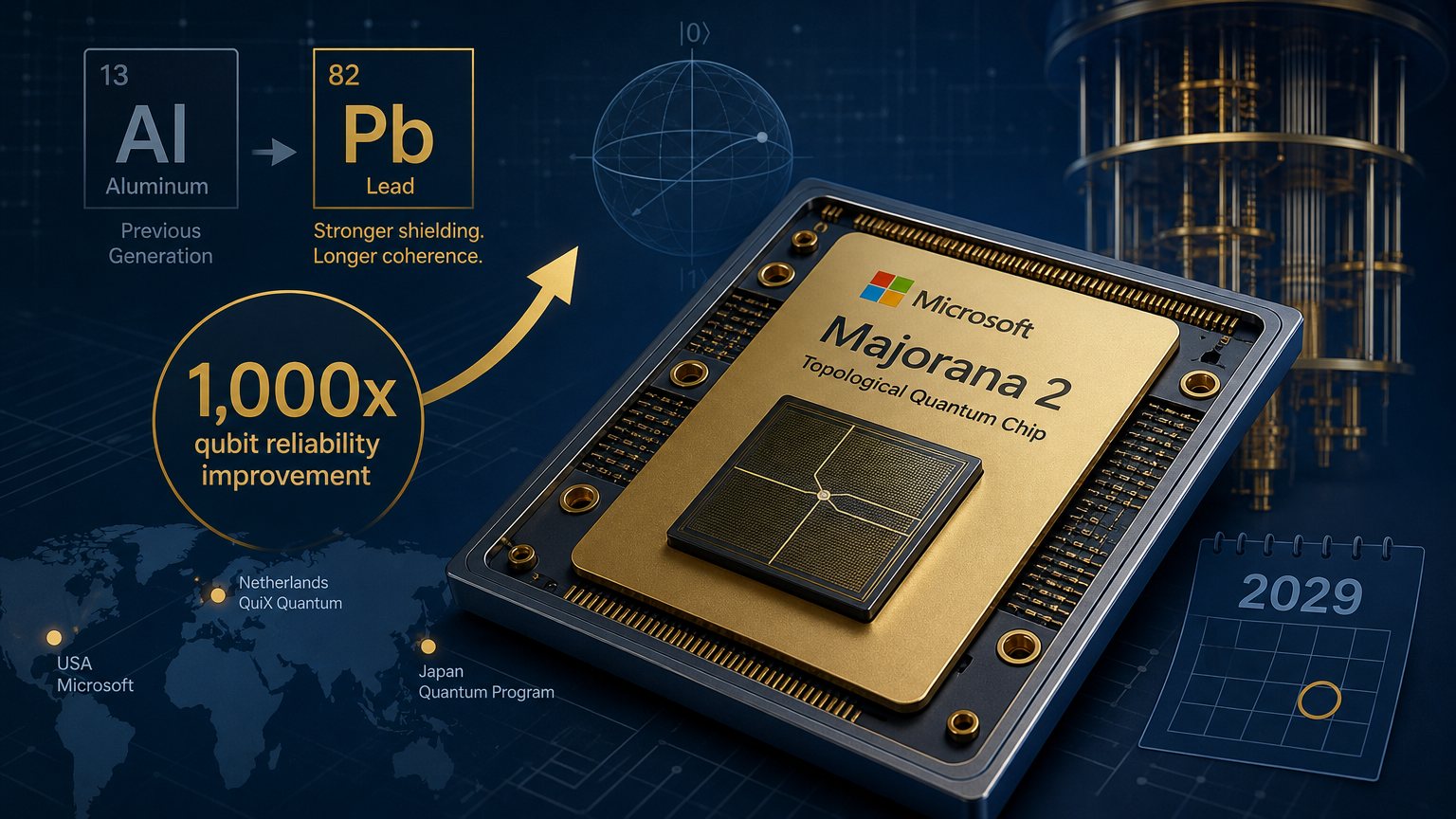
On June 2, 2026, Microsoft unveiled Majorana 2, its second-generation topological quantum chip. I spent the following week sitting with this announcement carefully, because I wanted to see whether the initial coverage was justified or whether this was another overhyped lab result dressed in press release language. After reading the technical details, my honest assessment is that this one is different. If you run infrastructure or build systems at any meaningful scale, you should have 2029 on your calendar as something other than an abstract future date.
What Actually Changed
The headline number is a 1,000-fold improvement in qubit reliability over Microsoft’s previous generation. That sounds like the kind of round number invented for press releases. It is not. The mean qubit lifetime on Majorana 2 is 20 seconds, with peak instances lasting as long as one minute. The previous generation operated in the millisecond range. A microsecond-class quantum operation on a 20-second-lifetime qubit is a fundamentally different engineering problem than the same operation on a millisecond-lifetime qubit — not a marginal improvement, a category change.
What enabled this leap was a single material substitution that sounds almost mundanely simple in hindsight: Microsoft swapped aluminum for lead in the chip’s superconducting layer. Lead provides superior shielding against the low-energy cosmic radiation and ambient vibration that knock qubits out of their quantum states. The physics are not complicated — lead has a higher critical temperature as a superconductor and magnetic properties that suit topological qubits better. The engineering reason it took years to implement is that lead introduced a cascade of fabrication tradeoffs that had to be resolved one at a time before the lifetime gains materialized in a reproducible, manufacturable chip.
For physical context: the Majorana 2 chip is about one-hundredth of a millimeter across. It operates under constraints — cryogenic temperatures near absolute zero, extreme electromagnetic shielding — that bear no resemblance to anything I deal with when planning server rooms or GPU clusters. But the eventual implications land in the same place: if these chips become commercially useful, they will reshape the compute landscape the way GPUs did after 2012.
AI Built the Chip That Could Change AI
The part of this story I find most compelling — and somewhat recursive — is how Majorana 2 was developed. Microsoft used its own Discovery agentic AI platform throughout the design and testing process. Not for marketing optics. For measurable productivity gains.
Quantum chip development involves a brutal experimental loop: fabricate a chip, run thousands of measurements, adjust hundreds of parameters, repeat. The parameter space is enormous, and the interactions between variables are not well-characterized in advance. Measurement cycles used to consume weeks of researcher time. Microsoft’s AI agents automated large portions of this cycle — managing parameter optimization, detecting qubit states from noisy measurement data, synthesizing knowledge across research teams distributed across multiple facilities, and flagging anomalies in fabrication processes before they became systematic failures.
The researchers retained final authority over conclusions. “Scientist in the loop” was Microsoft’s explicit framing, and based on the results, that framing seems honest rather than defensive. The chip is better because more of the experimental search space was covered in less time. That is exactly the right application for agentic AI — compressing cycles where the bottleneck is coordination and pattern recognition, not judgment about what matters.
I have been building AI systems long enough to be skeptical of AI-assisted-design claims. This one I believe, because the output is measurable. A chip that holds its quantum state for 20 seconds instead of milliseconds is not a narrative outcome. It is a physics result, and the only way to get a physics result is to run the experiments.
The 2029 Timeline: What “Commercially Useful” Actually Means
Microsoft’s revised projection is a commercially viable, scalable quantum computer by 2029 — roughly half the timeline they were previously citing. Before taking that at face value, it is worth being precise about what “commercially useful” means here.
It does not mean a quantum computer that replaces your data center. It means a quantum computer capable of running specific classes of problems — breaking certain encryption schemes, simulating molecular dynamics for drug discovery, solving optimization problems over large combinatorial spaces — where it has a meaningful advantage over classical hardware. Early commercial quantum systems will be narrow in application and expensive in access. But “narrow and expensive in 2029” has a documented history of becoming “broadly available by 2034” when the underlying technology is on a genuine exponential improvement curve. Majorana 2 suggests this curve may be steeper than anyone modeled two years ago.
The responsible caveat: as Neowin noted in their coverage, Microsoft has been in this position before. The original Majorana 1 announcement in 2023 included scientific claims that were later walked back after peer review found issues in the underlying data. I am not suggesting Majorana 2 is overstated — the 20-second qubit lifetime appears to be a real, measured result — but a company press release is not a peer-reviewed paper, and anyone building long-range strategy around this should track independent validation as it emerges over the coming months. The physics result and the commercial timeline projection deserve different confidence levels.
The Broader Race: Fault Tolerance Is Now the Metric That Matters
The quantum computing field shifted its priorities in 2026 in a way that has not gotten enough mainstream coverage. The raw qubit count race — how many qubits can you put on a chip — dominated the conversation for years. A June 6 TechTimes analysis documented that Microsoft, QuiX Quantum in the Netherlands, and Japan’s national quantum computing program are all now explicitly prioritizing fault tolerance over qubit count. The industry coalesced around the same conclusion the classical computing world reached in the mid-2000s: the raw count of the primary processing unit stopped being the meaningful metric. What matters is reliable, error-correctable computation.
On June 3, QuiX installed a Feed-Forward Control Unit achieving 150 nanoseconds of latency for photonic quantum operations — the complete window in which light travels about 30 meters, representing the full cycle needed for detection and reconfiguration in photonic systems. IBM’s Relay-BP decoder is cutting error-correction resource requirements by five to ten times compared to competing methods while running on standard field-programmable gate arrays, keeping the classical overhead practical enough to pair with near-term quantum hardware. The convergence of multiple organizations on fault tolerance in the same week is not a coincidence. It is the field signaling where the remaining hard problems actually live.
Microsoft’s topological qubit approach is specifically designed to be more inherently stable than the superconducting qubits used by IBM and Google, meaning it should require less error-correction overhead to reach fault tolerance. If that architecture advantage holds under independent validation, Majorana 2 is not just a better qubit — it is a better foundation for the scaling push that makes 2029 plausible.
Three Things to Do Now
I am not suggesting you restructure your technology roadmap around a 2029 quantum computer that does not yet exist. I am suggesting three concrete things you can do today.
- Start your cryptography inventory. Quantum computing’s most near-term threat to production systems is to current public-key encryption standards. NIST finalized its post-quantum cryptography standards in 2024. If you run systems that handle long-lived sensitive data — financial records, health data, regulated government information — you should be auditing cryptographic dependencies and mapping migration paths now. Three years is not a lot of runway for cryptographic infrastructure migrations, which have a habit of taking longer than anyone estimates.
- Watch Azure Quantum as the commercial on-ramp. The Next Web reported that Microsoft intends Majorana 2 to feed directly into Azure Quantum availability. If your organization already carries Azure commitments, the path to early quantum access will likely run through your existing commercial relationship. Get familiar with the Azure Quantum roadmap now so you are positioned to evaluate early access programs when they open rather than starting cold.
- Build your quantum-adjacent workload inventory. Your ops team does not need to change anything today. Your architecture team should be identifying which of your current workloads — optimization problems, molecular or financial simulation, combinatorial search, logistics scheduling — have characteristics where quantum speedup is theoretically meaningful. Having that list ready when 2029 arrives is the difference between being an early adopter and spending eighteen months catching up.
Why This Time Feels Different
I have been in this industry long enough to remember when GPU clusters were a research curiosity, when containerization was “too immature for production,” and when public cloud was “not suitable for regulated workloads.” Every one of those transitions happened faster than most infrastructure leaders expected once the underlying technology cleared a key reliability threshold. The transition from millisecond to 20-second qubit coherence has the character of that kind of threshold crossing.
The aluminum-to-lead swap, the AI-assisted design cycles, the 1,000x reliability improvement, the convergence of multiple research programs on fault tolerance as the key metric — these are not marketing artifacts. They are engineering results. The 2029 commercial timeline may slip. The technology will encounter obstacles not yet visible. But what Microsoft published on June 2 represents a genuine step change, not incremental progress relabeled as a milestone. I have run enough infrastructure to know the difference between an announcement that belongs in a press release and one that belongs in a planning document.
This one belongs in the planning document. Three years is not long. Start paying attention now.