The RAM and Storage Crisis of 2026: How Hardware Shortages Are Reshaping Server Procurement
Introduction
The data center industry is facing an unprecedented hardware crunch in 2026. Enterprise memory prices have reached crisis levels—32GB DDR5 RDIMMs now cost $1,000-$1,400 per module, with 64GB modules exceeding $2,400. Lead times from major vendors like Dell and Supermicro stretch from 6-8 weeks to potentially six months for certain configurations. Industry analysts project that memory shortages will persist well into Q4 2027 and beyond.
For IT managers and infrastructure teams, this perfect storm of AI-driven demand, geopolitical supply chain disruptions, and manufacturing capacity constraints has forced a fundamental reckoning: how do you keep your data centers running when new hardware is unaffordable or unavailable?
This article examines the causes of the current crisis, the actual enterprise pricing affecting procurement decisions, and practical strategies for navigating the shortage without breaking budgets or stalling critical infrastructure projects.
What's Driving the Crisis?
1. AI Boom Consuming All Available Supply
The explosive adoption of artificial intelligence and large language models has created insatiable demand for server-grade RAM and NVMe storage. Memory manufacturers have deliberately shifted capacity from mainstream segments (DDR4 and consumer DDR5) to higher-margin server DDR5 and HBM (high-bandwidth memory) used in AI accelerators. This structural shift means mainstream components are increasingly scarce and expensive.
2. Global DRAM Inventory Collapse
As of late 2025, average DRAM inventory levels have collapsed to just 8 weeks of supply, down from 31 weeks in early 2023. This is the thinnest safety margin in over a decade, leaving no buffer for disruptions or demand fluctuations.
3. Geopolitical Tensions and Trade Restrictions
Ongoing geopolitical tensions with chip manufacturing regions, coupled with export controls on advanced semiconductors, have constrained supply. Manufacturers are consolidating production and prioritizing high-margin products, leaving mid-market buyers competing for scraps.
4. Manufacturing Capacity Lag
New semiconductor fabs take 3-5 years to come online. While Micron's Idaho facility and SK Hynix's Yongin cluster are ramping toward volume production, they won't meaningfully impact the market until late 2027. We're locked into this shortage for the next 18+ months regardless of current demand signals.
The Numbers: Current Enterprise Pricing (March 2026)
Enterprise RDIMM Memory - Shocking Price Reality
DDR5 Enterprise Memory (RDIMM - Current Pricing via memory.net):
- 32GB DDR5-4800 RDIMM: $998
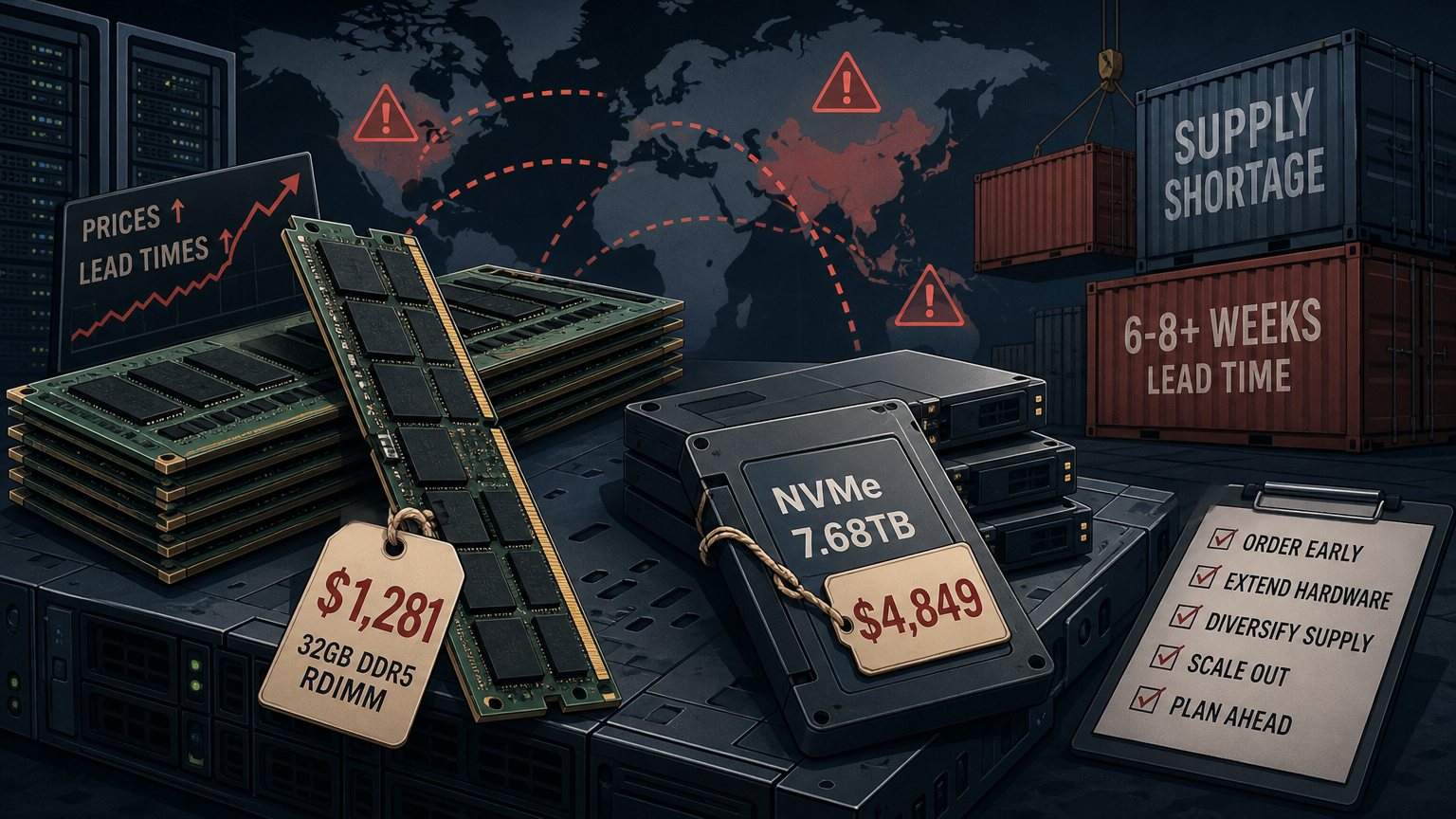
- 32GB DDR5-5600 RDIMM: $1,281
- 32GB DDR5-6400 RDIMM: $1,424
- 64GB DDR5-4800 RDIMM: $2,408
- 64GB DDR5-6400 RDIMM: $2,498
For comparison - DDR4 Enterprise Memory:
- 32GB DDR4-3200 RDIMM: $460
The Math on a Dual-Socket Server:
A standard dual-socket server with 16 DIMM slots maxed out at 32GB per DIMM:
- DDR5 @ 32GB modules: 16 DIMMs × $1,281 (mid-range DDR5-5600) = $20,496 in memory alone
- DDR4 @ 32GB modules: 16 DIMMs × $460 = $7,360 in memory alone
This doesn't include CPU costs, storage, or licensing. Just memory can now exceed $20,000 for a single server.
Price Escalation Trajectory
Industry forecasts expect continued 20-30% quarterly increases through Q2 2026. The memory market is now in open shortage mode—prices are set by supply scarcity, not manufacturing costs.
Server OEM Pricing Impact
Major OEMs are passing component costs directly to customers:
- Dell, Lenovo, HP, and HPE are implementing price increases of approximately 15-25% across server lines
- These increases are on top of the component cost escalations already reflected in pricing
Lead Times by Vendor (March 2026)
| Vendor | Current Lead Time | Year-ago Lead Time | Change |
|---|---|---|---|
| Supermicro | 2-4 weeks | 1-2 weeks | +100% |
| Dell | 6-8 weeks | 2-3 weeks | +200% |
| Lenovo | 6-8 weeks | 2-3 weeks | +200% |
| HPE | 6-8 weeks (est.) | 2-3 weeks | +200% |
Caveat: These are standard configurations. Custom builds with specific memory configurations frequently see lead times extending to 20-26 weeks or longer.
How Long Will This Last? The Forecast Through 2028
Short Answer: Much Longer Than You'd Like
Q2-Q4 2026: Acute shortages, continued price escalation at 20-30% quarterly
2027: Gradual improvement beginning in late 2027, but continued elevated pricing
Late 2027: Partial supply normalization as new manufacturing capacity comes online
2028+: Expected return to more normal pricing (though likely 40-60% above pre-2024 levels)
Why So Long?
The semiconductor industry operates on multi-year cycles. Foundries made capacity decisions in 2024-2025 based on then-current demand. New fabs won't produce volume until 2027-2028. We're locked into this shortage regardless of whether demand shifts.
Strategy 1: Extend and Upgrade Existing Hardware
When new infrastructure costs $20,000+ per server in memory alone, extending existing hardware becomes economically essential.
The Economic Case for Older Hardware
5-7 year old servers often have compelling advantages:
- Paid off: No ongoing financing costs
- Reliable: You understand their failure modes and quirks
- Sufficient: If they've handled your workloads this far, they can continue
- Cheap to upgrade: Targeted memory upgrades at $460-$1,400 per DIMM are far cheaper than new systems
Targeted Upgrades That Pay Off
Memory Expansion:
If your 2016-2019 era servers have available DIMM slots, maxing them out costs a fraction of new hardware. Adding 4 DDR4 RDIMMs @ $460 each = $1,840 vs. $15,000+ for new systems.
SSD Migration:
Replacing aging mechanical drives with enterprise NVMe drives dramatically improves performance with minimal cost compared to hardware refresh cycles.
Firmware Updates:
Often free or minimal cost, can unlock performance improvements.
When NOT to Extend Old Hardware
- End-of-life support: Unsupported systems pose security risks that exceed upgrade costs
- Thermal constraints: Some older chassis cannot accommodate modern DIMMs
- Mechanical failure risk: 7+ year old systems may be near end-of-life
Strategy 2: Order Early and Order Aggressively
If you need servers in Q3 2026 or later, order NOW to lock in current (relatively) pricing and lead times.
Front-Loading Economics
Early orders typically see 25-35% faster fulfillment. The difference between Q1 and Q3 2026 ordering could mean:
- 8-week lead times vs. 16-20+ week lead times
- Current pricing vs. 20-30% higher pricing
Standardize on Fast-Path Configurations
- Standard off-the-shelf builds (minimal customization)
- 1-socket systems over 2-socket (dual-socket is high-demand)
- Standard memory configurations (avoid maximum-capacity DIMMs)
Leverage Vendor Priority Programs
Major OEMs offer allocation programs. Negotiate for priority access if you have significant volume ($500K+/year) or multi-year commitments. These programs can shave 6-8 weeks off lead times.
Strategy 3: Diversify Your Supply Chain
Multi-Vendor Strategy
Maintain relationships with multiple OEMs:
- Primary vendor: Your preferred partner (Dell or Supermicro)
- Secondary vendor: Another tier-1 OEM (HPE, Lenovo, Cisco)
- Tertiary option: System integrators or regional providers
When lead times blow out at your primary vendor, alternatives become invaluable.
Refurbished and Secondary Markets
Secondary market channels increasingly stock late-model refurbished enterprise hardware:
- 20-40% discount vs. new hardware
- Excellent for dev/test environments
- Good for capacity buffering
Strategy 4: Rearchitect Around Constraints
Scale Out vs. Scale Up
Rather than waiting for high-end dual-socket flagships, deploy clusters of smaller single-socket systems:
- Faster individual system delivery
- Distributed redundancy (single failure impacts smaller percentage of capacity)
- Better workload right-sizing
Leverage Cloud for Overflow
Cloud overflow for constrained workloads may be more cost-effective than:
- Waiting 6+ months for on-prem capacity
- Paying for idle infrastructure while waiting for hardware
- Over-purchasing to compensate for long lead times
The Decision Matrix
| Situation | Recommendation |
|---|---|
| Have budget and roadmap | Order aggressively in Q2 2026; lock in pricing and lead times |
| Current hardware is 5-7 years old and functional | Extend with targeted upgrades (memory, SSD); delay new purchases to Q3-Q4 2026 |
| Need capacity urgently (next 8-12 weeks) | Upgrade existing hardware; avoid long-lead OEM orders |
| Have flexibility on architecture | Adopt scale-out approach; order multiple smaller systems |
| In a capital-constrained environment | Extend existing hardware aggressively; explore secondary market options |
Closing
The memory shortage of 2026-2027 is not a short-term disruption—it's a structural market condition that will persist for 18+ months. Organizations that acknowledge this reality and plan accordingly will weather the crisis far better than those hoping for a quick return to normal conditions.
At $1,000-$2,400+ per DIMM, every procurement decision carries significant financial weight. Plan accordingly.
Enterprise NVMe/SSD Pricing (March 2026)
Enterprise NVMe Storage:
- Dell 15.36TB PCIe Gen 4 NVMe: $5,000.50 (~$325/TB)
- Solidigm 7.68TB Enterprise SSD: $4,849.00 (~$631/TB)
- Solidigm 1.92TB SATA SSD: $1,228.74 (~$640/TB)
Enterprise storage has become as expensive as memory. A dual-socket server with 4 NVMe drives at 7.68TB each = 30.72TB of storage at a cost of ~$19,396 in drives alone. Combined with $20,496 in memory, you're looking at $40,000+ in just RAM and storage for a single server.
The Total Cost Impact
A fully-equipped dual-socket enterprise server in Q1 2026:
- Memory (16 × 32GB DDR5): $20,496
- Storage (4 × 7.68TB NVMe): $19,396
- CPUs, Motherboard, PSU: $8,000-12,000
- Total Hardware Cost: $48,000-52,000+ per server
This doesn't include licensing, networking, or installation. At these price points, extension of existing hardware moves from "cost optimization" to "financial necessity."