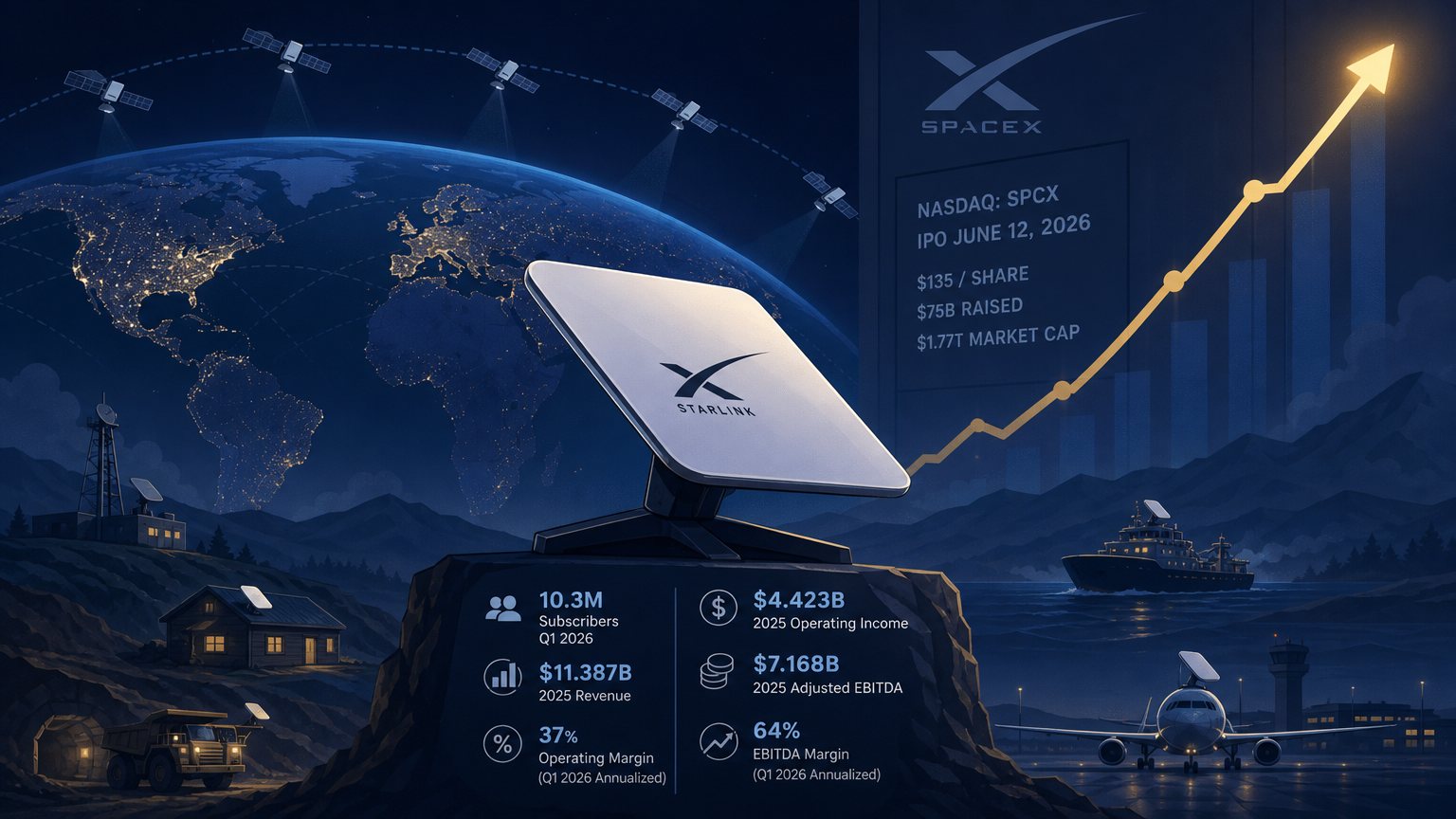
When SpaceX priced its IPO at $135 per share on June 12, 2026 — raising $75 billion and debuting on Nasdaq as SPCX at a $1.77 trillion market cap — the financial press declared it the largest initial public offering in Wall Street history. Talking heads argued about whether the valuation was reasonable. Retail traders chased it to $161 on the first day, a 19% pop from the offer price. I tuned most of that out.
What caught my attention was buried deeper in the prospectus: the Connectivity segment — which is primarily Starlink — generated $11.387 billion in revenue in 2025, with $4.423 billion in operating income and $7.168 billion in adjusted EBITDA. After 24 years as a private company, and years of engineers and operators asking whether Starlink is actually real enterprise infrastructure, we finally have audited answers. Those answers are more interesting than the IPO price.
The Numbers Wall Street Mostly Missed
Let's start with the income statement, because this is where the story gets genuinely unusual for a satellite company.
In 2025, the Connectivity segment grew 49.8% in revenue, 120.4% in operating income, and 86.2% in EBITDA year over year. In Q1 2026 alone, it generated $3.257 billion in revenue on $1.188 billion in operating income and $2.087 billion in adjusted EBITDA. Annualize that Q1 run rate and you're looking at roughly $13 billion in revenue with 37% operating margins and 64% EBITDA margins. Those are not the margins of a satellite company. They are the margins of a software company that happens to run on top of a satellite network.
That framing matters. SpaceX built a recurring-revenue SaaS business in low Earth orbit. The hardware — 9,600+ satellites, ground stations, dish terminals — is the capital investment. Once the constellation is in orbit, each incremental subscriber adds high-margin recurring revenue at near-zero marginal cost. The S-1 makes this flywheel visible for the first time: Starlink's margins look more like Salesforce than Lumen Technologies.
The subscriber numbers back this up. Starlink served 10.3 million subscribers as of Q1 2026, up from 2.3 million two years earlier. That is a 4.5x increase in 24 months. The growth rate has started to flatten slightly — expected as early adopters saturate high-income markets — but margin expansion continues, suggesting the business is far from a plateau.
The counterweight worth naming: SpaceX has accumulated $41.3 billion in total losses since its founding in 2002. The Connectivity segment is profitable and growing, but the Space and AI segments continue to consume capital. This is simultaneously a high-margin recurring revenue business and a capital-intensive rocket manufacturer. That tension will play out in public markets over the next several years, and it is a genuine risk for long-term infrastructure planning.
The ARPU Decline Is Not a Warning Sign
A lot of financial analysis has fixated on average revenue per user dropping from $99 per subscriber per month in 2023 to $66 per subscriber per month by Q1 2026. Some commentators presented this as a red flag.
It is not. Not for a subscriber-driven infrastructure business scaling globally.
The ARPU decline reflects geographic and plan mix shift. Early Starlink subscribers were predominantly in the United States and Western Europe on premium residential and business plans. Growth since then has come from Latin America, Southeast Asia, Africa, and maritime and aviation customers, where price points are intentionally lower — some subsidized by governments for rural connectivity mandates. Revenue and operating income are both expanding rapidly despite the ARPU compression, which means the underlying subscriber unit economics still work.
The business model does not require high ARPU. Once the constellation is in orbit, marginal cost per new subscriber approaches zero. SpaceX ships the dish at hardware cost, collects the recurring subscription, and the bandwidth is largely already provisioned. That flywheel becomes more favorable, not less, as global subscriber density increases and existing satellite capacity is more fully utilized.
Where Starlink Actually Fits in Real Infrastructure
I have run data center operations and managed wide-area networks long enough to have specific opinions about when satellite internet makes sense. Starlink has been on my radar since the early trials. Here is how the confirmed financials change my thinking.
The latency profile — 20 to 40 milliseconds on Business plans, confirmed by independent performance testing in 2026 — is real and acceptable for a large class of enterprise workloads. It is meaningfully better than legacy geostationary VSAT at 600ms and above. Starlink still cannot replace fiber for latency-sensitive applications: sub-20ms database replication, real-time financial transaction routing, synchronous VoIP at scale. But for a lot of what most teams actually do, it is now competitive.
The use cases I am reconsidering most seriously:
- Backup WAN circuits. For edge sites where a fiber cut is a real outage risk, a $250 to $500 per month Starlink Business link as a cold standby makes both operational and economic sense. The IPO financials confirm the company has the resources to maintain service continuity. The EBITDA profile means they are not burning cash to keep the lights on.
- Remote and rural compute. If you are operating infrastructure at industrial edge sites, resource extraction operations, or remote sensing deployments, Starlink is now the obvious connectivity choice where fiber does not reach. The product is commercially mature and the operator is publicly accountable.
- Maritime and aviation. Starlink Aviation and Maritime are commercial offerings with real operational history. These are no longer beta products. The S-1 treats them as significant contributors to the Connectivity segment.
- Disaster recovery and emergency ops. LEO satellite connectivity is resilient to terrestrial outages. For DR site connectivity planning, that independence from ground infrastructure is meaningful. A fiber cut, a flood, a power grid failure — none of these take down a satellite link the way they take down ground infrastructure.
The gap that remains is worth stating clearly: Starlink Business does not offer a financially backed SLA with penalty credits for downtime in the way an enterprise MPLS circuit or major fiber provider does. You are buying priority bandwidth allocation and SpaceX's operational track record, not contractual uptime guarantees with SLA credits. Build your failover logic accordingly — treat it as high-quality best-effort, not guaranteed availability.
The xAI Wildcard
In February 2026, SpaceX acquired xAI — Elon Musk's AI startup — folding Grok, its data centers, and the social network X into the SpaceX corporate structure. The S-1 now lists three business segments: Connectivity (Starlink), Space (launch services), and AI (xAI and associated assets).
I will be honest: the implications of this are genuinely unclear and anyone who tells you otherwise is probably guessing.
The credible bull case is that SpaceX uses xAI capabilities to improve satellite operations — beam scheduling, interference management, spectrum optimization — which are real engineering problems with meaningful AI applications. There is also a plausible story about Starlink terminals evolving toward AI-edge compute nodes, with the global subscriber base as both a distribution channel and a training data source. Ten million geographically distributed endpoints is an interesting edge compute substrate.
The credible bear case is that absorbing xAI — with its own data centers, model infrastructure, social network operations, and regulatory entanglements — is organizational complexity layered onto an already capital-intensive business, right at the moment it needs to demonstrate public market discipline. The Space segment still operates on negative margins. Adding an AI division to that mix introduces execution risk that did not exist before.
I am watching this carefully but not letting it drive my infrastructure vendor decisions. Starlink the connectivity product is what it is regardless of the parent company's AI roadmap.
What Public Company Accountability Actually Means
Here is something that matters for anyone treating Starlink as infrastructure: SpaceX is now a public company, and that changes the nature of the dependency in a meaningful way.
Public companies file quarterly 10-Q and annual 10-K reports. Their finances are audited and SEC-scrutinized. Analysts model their margins and grill management on earnings calls. For an infrastructure dependency, that transparency is valuable in ways that private company relationships are not. You can now read the 10-Q and assess Starlink's financial health the same way you would read an AWS or Azure earnings report to understand whether the platform you depend on is investing appropriately or being milked.
The trade-off is that public markets create quarterly earnings pressure on a business that requires decade-scale capital investment in satellite manufacturing, launch cadence, and constellation replenishment. I will be watching whether shareholder pressure distorts SpaceX's infrastructure investment cadence over the next several years. For now, the Connectivity segment's profitability provides real insulation — it is generating enough EBITDA to self-fund ongoing investment without requiring capital markets support for operations.
My Updated Infrastructure Playbook
For several years, the honest answer when an engineering team asked whether to use Starlink for backup connectivity was: the technology is impressive, but the company's finances are opaque and we cannot fully assess service durability. That answer changed on May 20, 2026, when SpaceX filed its S-1. It changed again on June 12 when the largest IPO in Wall Street history was oversubscribed by institutional investors who had seen the actual numbers.
The Connectivity segment is profitable, growing at 50% per year, generating over $7 billion in annual EBITDA, and serving 10.3 million subscribers across a 9,600-satellite constellation. Those are numbers that justify treating Starlink as a durable infrastructure provider — not a startup experiment you adopt at your own risk.
I am not moving primary workloads off fiber. Fiber still wins on latency, SLA guarantees, and raw throughput consistency for applications that need them. But I am updating my approved vendor list: Starlink Business goes on for backup WAN circuits, remote and rural edge deployments, maritime operations, and disaster recovery connectivity.
The IPO did not change what the product does. It just told me, finally, whether the company will be around to keep running it. And for the first time, I have audited evidence that the answer is yes.